
A Practical Guide to Choosing Project Management Support in Phuket

Building a villa, hotel, resort or commercial property can become difficult long before anything visibly goes wrong. Drawings change. Decisions wait for approval. Costs move. Contractors need information. The owner receives several versions of the same story and has to decide which issue needs attention first.
Professional management gives the owner a clearer view of the project and a defined process for making decisions. The question is not simply whether you need a project manager. It is how much support your project needs now.
KEY IDEA: Choose the management role according to the project's current stage, existing team, contract structure and control gaps. The level of support can change as the project develops

Start with the decision you need help making
Owners usually seek management support because one or more decisions have become difficult to make with confidence.
You may need to know whether the design is coordinated before tender. You may need better visibility over changes and their effect on cost or schedule. You may need someone to follow daily site issues, or an independent person to review progress at important milestones.
The useful starting point is therefore the owner's problem, not the job title.
If the whole project needs connected leadership, consider Project Management.
If construction activity needs active site-level coordination, consider Construction Management.
If the team is functioning but you need independent periodic input, consider Owner's Representation.
PRACTICAL TIP: Before asking for a proposal, write down the three decisions that currently cause you the most uncertainty. They will help define the scope more clearly than a generic request for project management services.
Project Management connects the whole project
Project Management has the widest view. It can connect the owner's brief with feasibility, design, consultant appointments, procurement, contracts, budget, schedule, construction and handover.
For an owner, the practical value is visibility.
Design coordination can expose conflicting information before it reaches the site.
Schedule reviews can identify decisions that threaten future milestones.
Change control can show the likely cost and time implications before approval.
Reporting can turn separate consultant and contractor updates into one clearer picture.
The exact service depends on the appointment. Project Management does not automatically include every design, engineering, legal or quantity-surveying duty. Those responsibilities remain with the professionals appointed to perform them.
The architect and specialist designers remain responsible for their design services. Engineers remain responsible for their technical disciplines. The quantity surveyor retains the cost and measurement duties in its appointment. The contractor carries out the work and retains its contractual site-safety duties. Lawyers and authorities retain their legal and statutory roles. A developer or property manager has a separate commercial or operational function.
Construction Management focuses on delivery
Construction Management becomes most important when work is being carried out and daily interfaces affect progress, quality, cost and completion.
Constructive Management may coordinate contractor activities, monitor the schedule, review work visually against approved information, manage meeting actions and project records, follow changes and requests for information, and coordinate inspections, testing, defects, commissioning and handover.
This does not give unlimited authority. The contracts and Constructive Management appointment determine who may approve a design change, certify a payment, issue a binding instruction or accept completed work. When another party holds that authority, Constructive Management coordinates the information and decision instead of assuming the role.
Periodic inspection is also different from continuous supervision. A Construction Manager cannot guarantee that every defect will be found. Technical certification remains with the appointed designer, engineer or other qualified professional. The contractor retains its contractual responsibility for site safety, even where Constructive Management observes and reports concerns
WATCH OUT: A broad title can hide a narrow appointment. Check the written scope, authority, attendance, reporting and exclusions before assuming what a Project Manager or Construction Manager will do.
Owner's Representation provides independent periodic input
Some projects do not need another full-time management layer. If the consultant team and contractor are capable, contracts are clear, records are current and daily site management is functioning, the owner may need only periodic independent support.
Constructive Management uses the term Owner's Representation for this type of appointment. It may include selected meetings, milestone reviews, progress visits, defect inspections, handover inspections and advice on decisions that require the owner's attention.
Owner's Representation is less suitable when responsibilities are unclear, design and construction information conflict, changes are poorly recorded, cost or schedule reporting is unreliable, or important issues remain open without action. Those conditions may require more active management.
The terminology varies across the industry. The written appointment matters more than the title.
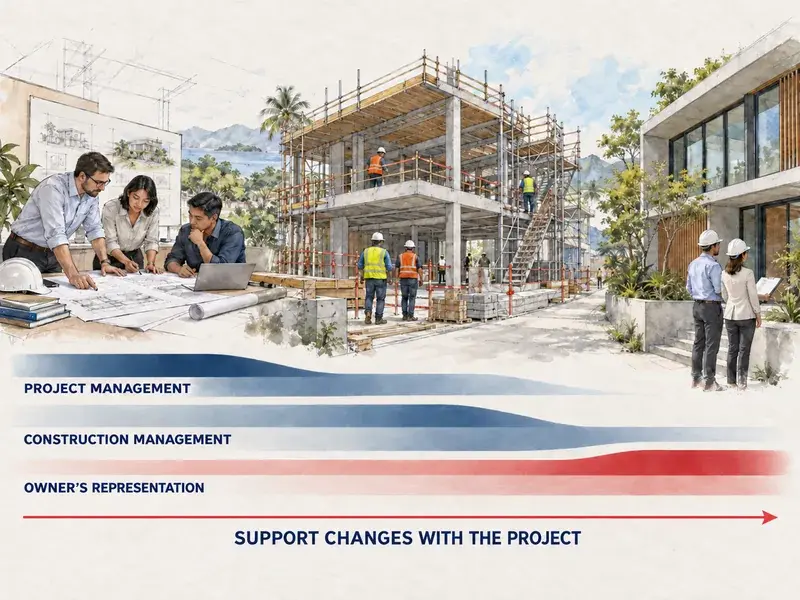
The level of support can change
A project rarely needs the same management intensity at every stage.
An owner may use Project Management during design and procurement, add Construction Management resources when site activity increases, then reduce the appointment to periodic Owner's Representation during closeout. A project already under construction may need short-term support for a difficult phase, defects, stalled decisions or handover.
Constructive Management can review an active or troubled project, but it should not promise recovery before understanding the evidence. The review starts with appointments, contracts, drawings, records, schedule, cost information, site conditions and unresolved issues. The resulting scope should address the control gaps actually found.
DEEPER DETAIL: Cost support also depends on scope. Constructive Management may monitor an approved budget, forecast, variations, commitments or payment information. This does not automatically replace an independent quantity surveyor's measurement, valuation or certification role.
Use this five-question decision check
What stage is the project at? Planning, design, tender, active construction, defects and handover require different types of attention.
Who is already appointed? Identify the Architect, Engineers, Quantity Surveyor, Contractor, specialists and the person currently coordinating them.
Where is information breaking down? Look for unclear decisions, conflicting drawings, late reports, unmanaged changes, open defects or missing records.
How much site presence is needed? Consider the pace and risk of work, not a standard visit frequency.
What authority must the manager have? Define who may instruct, approve, certify, accept, report and escalate.
Your answers point towards the likely level of support. They also give Constructive Management the information needed to prepare a useful proposal.
TRY THIS: Take the most recent progress report or meeting minutes and check whether every important issue has an owner, a due date and a recorded decision route. Missing information often reveals the management gap.
Choose the firm as carefully as the service
A proposal should describe the people and process, not only the service title. Ask who will lead the appointment, attend the site and prepare or review reports. Check how the firm will record decisions, actions, changes, schedule, cost, quality, risks and defects.
The proposed scope should state authority, site attendance, staffing, deliverables, reporting, duration and exclusions. It should explain how the manager will work with the owner, architect, engineers, quantity surveyor, contractor, specialists and suppliers. Independence from contractors and suppliers should be clear, together with any other relevant relationship or conflict.
Experience should match the role, project type, location and stage. Confirm that project examples and references support the responsibilities being proposed.
Relevant experience in Phuket
Constructive Management's public portfolio records appointments across hospitality, private villas and commercial hospitality in Phuket.
At the 161-room Hyatt Place Patong, Constructive Management is recorded as Project and Construction Manager, with responsibilities involving design consultants, contractors, value engineering and change control.
For private villas at Cape Yamu, Constructive Management is recorded as Project and Construction Manager under design-build contracts, including project, construction and budget-management responsibilities.
For Café del Mar in Kamala, Constructive Management is recorded as Project and Construction Manager across phases involving the beach club, restaurant, bar, parking, back-of-house and related work.
These examples show the range of project settings. A new appointment is still defined around the new project's facts.
Key takeaways
Choose the role according to the decisions and control gaps the owner needs help managing.
Use Project Management for broad coordination, Construction Management for active delivery control and Owner's Representation for periodic independent input.
Confirm authority and professional boundaries in writing. A management title alone does not define contractual powers.
Adjust the level of support as the project moves through design, construction, defects and handover.
Treat clear reporting as decision evidence, not merely a record of site activity.
Discuss your project
Constructive Management works primarily in Phuket and also supports projects in Southern Thailand and Bangkok. The first step is a confidential discussion about the project, team, contracts, current stage and principal concerns.
Constructive Management can then define a custom scope covering responsibilities, authority, site attendance, reporting, staffing, deliverables, duration and exclusions.
Discuss your project at
Common questions
Do I need to appoint Constructive Management before the Architect or Contractor?
No. Early involvement can help coordinate the brief, team and procurement, but Constructive Management can also join after consultants or contractors are appointed. The role is defined around the existing project structure.
Do I need a Construction Manager if I already have a Contractor?
Possibly. The contractor performs the work. A Construction Manager provides owner-side coordination, monitoring, records and reporting within the agreed scope. The need depends on the project team, risks and the level of independent visibility required.
Can Project Management and Construction Management be combined?
Yes. A combined or phased appointment can connect broad project leadership with active construction-stage control. The resources and attendance can change as the project develops.
How often should a Construction Manager visit the site?
Attendance should reflect the stage, pace and risk of work, contractual arrangements and agreed scope. One standard frequency will not suit every project.
Continue learning
Continue with What Does a Construction Project Manager Do? From First Idea to Handover, What Does a Construction Manager Do On Site? Daily Control of the Work, and What Does an Owner's Representative Do in Phuket? for a closer look at each service.


